You won’t want to miss this interview with Kathy Weitz of Cottage Press! We discussed her own life-long learning story, Charlotte Mason and Classical education, and the joys of a read-aloud family culture.
Watch the video, read the show notes, and share with your friends!
Prefer to listen to your content? Subscribe to Homeschool Conversations wherever you get your podcasts!
Who is Kathy Weitz?

Kathy Weitz is a lifelong Virginian and a lifetime learner. For more than twenty-five years as she and her husband Rick educated their six children at home, she pursued a classical education for herself as well. In addition to her own children, she has taught a number of other students, both online and in the classroom.
Kathy holds an M.A. in Christian and Classical Studies from Knox Seminary. She serves as the Dean of Academics at Loudoun Classical School, a collegiate model Christian classical school, where she teaches Arts and Letters, Literature, and Latin. She also serves as an adjunct professor of Rhetoric at Patrick Henry College. Kathy Weitz blogs at TheReadingMother, and her Language Arts curriculum can be found at Cottage Press Publishing.
{This post contains paid links. Please see disclaimer.}
Show Notes {with video time stamps}
Kathy’s Early Years of Homeschooling {1:25}}
The Weitz family has 6 children who currently range in age from 32 to 20. They were homeschooled pretty much all the way through.
Kathy and her husband, Rick, had heard radio programs about homeschooling on Focus on the Family even before they had kids. They thought “OF COURSE that’s what we’ll do.” But then…Kathy had twins. And when it came time to potty train them and teach them to tie their shoes? It was such a challenge that she thought, “There’s no way I could teach them to read!”
(Also, I simply have to interject this here: Potty training more than just about anything else has caused me to question everything about my parenting. Why is it so hard?! Anyone else?)
The twins had a very good experience at the small, local Christian preschool, but options for schools after that were not good, feasible options for the Weitz family.
Cost was definitely one significant part of that equation. But Kathy was also concerned about the large amount of time required from homework at the early grades. She thought surely she could homeschool them herself in less time than that!
Finally, a friend told her to stop talking about homeschooling and just do it!
For the Children’s Sake, picked up at a homeschool convention she was dragged to by another friend, sealed the decision to homeschool. As she read the book she thought, “This is exactly what I want, and this is what I can do.”


The Chronicles of Narnia and Anne of Green Gables had been huge literary influences in Kathy’s growing up years, and as she read Susan Schaeffer Macaulay she thought that somehow Charlotte Mason’s principles must have been communicated to L. M. Montgomery.
The philosophy expressed in For the Children’s Sake resonated deeply with Kathy and provided her with a framework and educational vision for her homeschool. So Kathy’s family took a Charlotte Mason (which Kathy would argue is also Classical) approach from the very beginning.
Early Homeschool Practices and Habits {4:50}
Reading aloud was the central, most important part of homeschool life! Kathy didn’t call it Morning Time back then (as this type of learning might be known today), just Reading Time. She and her kids would spend hours and hours reading together on the couch.
Every once in a while, she’d worry she wasn’t doing enough. She’d buy some program with lots of busy work and they’d frantically do it for a while until they all collapsed on the sofa and went back to reading aloud together.
“From the very beginning that is the one thing I’d say has always been a constant: the reading aloud. I’m so grateful for that,” Kathy observed.
Some of the Weitz family’s favorite books:
- Chronicles of Narnia
- The Hobbit
- The Anne of Green Gables series
- Living history books (Archimedes and the Door of Science, Galen and the Gateway to Medicine, etc)
- Historical fiction
- Biographies
- Missionary stories
- Tons and tons of Bible
Kathy remarked, “I learned more about the Bible while homeschooling than I think I had learned in my entire adult life up to that point.”
Anything she thought her children needed to read, they would read together. Kathy didn’t make her kids go off and read these core books all by themselves. Sometimes the children would read Landmark books independently for fun, but the core of their reading for content in the early years was done together.
Kathy observed that in a large family, we’re most often “reading to the oldest kids and the youngest kids just come along.”
So will the youngest children in a large family miss out on those stories? No!
At certain points, Kathy would take her middle children before naptime and read books like 5 Little Peppers aloud in order to make sure that they heard the stories she had read aloud previously to the oldest kids.
The most precious story Kathy recounted brought such joy to my heart. When her youngest son was getting to the end of high school, they had just finished reading aloud together all of Dante’s Divine Comedy and Milton’s Paradise Lost. Kathy asked her son to humor her and let her read aloud Chronicles of Narnia with him in those final 6 months before graduation, since he had been too young to really remember when she had read it aloud to his older siblings all those years before.
“One of my favorite homeschool memories was reading that with my 18-year-old,” Kathy said.
My heart was so full hearing her recount this story! Such an encouragement to realize that it’s never too late to read beautiful stories aloud with your children!
Changes and Homeschool Growth Over the Years {9:05}
Changing seasons bring constant changes, Kathy reminded us. “Every time you hit a new season with one kid you end up with some new thing you have to figure out…which is why homeschooling is never boring.”
As the years went by, Kathy grew in her understanding of what education really could and should be. Early on she had received wonderful ideas from authors like Susan Schaeffer Macauley and Susan Wise Bauer. As the children got older, however, and she was considering language arts and composition curriculum, she just couldn’t find anything like what she was looking for.

She began to ask, “What should [education] look like? And what does it mean?”
Kathy began to read the classics themselves, not just books about them. And as she was reading Plato, Aristotle, and Augustine she was learning what education really should be. She finally had the language to express the idea that education is about forming our children’s affections, forming them to be people who love God and love their neighbor.
One of her favorite definitions of classical education came from what was once almost a throwaway comment from Dr. Christopher Perrin: “Classical education is fitting our kids for heaven.” Kathy believes that education is fitting our children for their place in the kingdom of heaven and, by doing so, it fits them for their place here and now.
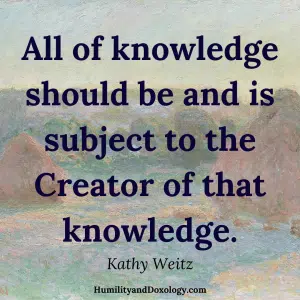
“All of knowledge should be and is subject to the Creator of that knowledge,” Kathy urged. Our education is to form us and fit us for the glories to come, and also to fit us to do God’s work here in this world.
Kathy also learned as her children grew older that finding outside teachers was especially important in those disciplines where someone else could inspire wonder better than she could. It was hard to relinquish control, but it was better for her children.
Advice for the Mama Considering Charlotte Mason and Christian Classical Education {13:10}
Kathy’s response was profound.
“You are doing a great thing for yourself. You think this is for your kids. This is really for you. (It’s for your kids, too.) You’re going to learn and grow along with your kids. That is an amazing thing in itself, but it’s also the most inspirational thing you can do for your kids. They’re going to see you working to learn, and that has more impact on them than you can possibly believe.”
As we classically educate ourselves alongside our children, we are setting a pattern before them of what life-long learning can and should look like.
Kathy also encouraged us that “it’s not selfish” for us to pursue our own studies of what we love. “Whatever it is that’s your passion, do that with all your might.”
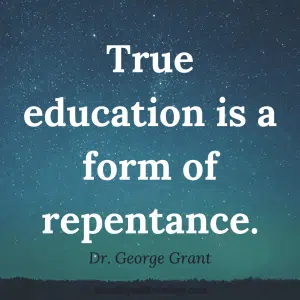
I was so excited to hear Kathy reference a favorite quotes from one of my heroes, Dr. George Grant: “Education is repentance.” Education ought to be a constant repenting of what we don’t know.
“Pursue your own education and bring [your children] along with you,” urged Kathy. We don’t have to worry so much about picking the perfect content for our studies. Instead, focus on being faithful. Even if it’s only 5 or 10 minutes a day, those little moments add up to an amazing thing by God’s grace.
Where should Mom start? {17:00}
Kathy has a two-fold plan for us.
Start with
- What you love
- What you lack
Sometimes the teachers are the lead learners, Kathy reminded us, not necessarily the ones who have it all figured out.
Kathy also spoke to the value of giving our older kids the benefit of a tutor, sitting in, and learning alongside them. Later, we can then pass that knowledge on to our younger children or even someone else’s children in the future!
For example, Kathy learned Latin when she was 40, so don’t think you’ve missed the chance to learn new things. She was also inspired later to learn that Plutarch learned Latin in the “decline of his life” so that he could write his Lives!
Wondering where to start? Start wherever you are.
Kathy acknowledged that life situations can be a challenge, but she encouraged us that we can always read, even if circumstances make other types of study more difficult. Whatever the amount of time is that you have, make the task at hand, whatever it is that you’ve decided to learn, a priority.
Kathy Weitz and Cottage Press Publishing {20:00}
Be sure to check out all of the fabulous offerings at Cottage Press Publishing. (You can read my review of the Cottage Press Poetry Readers here.)
Kathy Weitz has the beginnings of a humanities/arts and letters curriculum in the works at Cottage Press. Right now, it is being shared for free!
Mostly, she is focused on finishing her Language Arts program, which is designed to begin after a child has finished phonics (around grade 2) and progress to 10th or 11th grade.
The Language Arts Program from Cottage Press is based in classical principles: there is lots of imitation and beautiful literary selections. It also is inspired by Charlotte Mason’s philosophy: copywork, nature study, and even art study are included in the early levels of the language arts curriculum.
Some people might wonder why nature study and art study are included in a Language Arts program, but Kathy is undeterred. “Being able to observe and tell is foundational to being able to write.”
The Cottage Press books move through the levels of the progymnasmata. (Not sure what that is? Here’s a good explanation.) For the classical world, the progymnasmata was designed to develop the rhetorical art of oratory, but for us moderns it’s mostly about developing the rhetorical art of writing.
In Junior High and High School levels, Cottage Press uses literature as the main source for writing. It facilitates a deep dive into just a few books, which frees you up to read more widely in your Humanities curriculum.
Wise Words from a Veteran Homeschool Mom {25:45}
I love Kathy’s first response when I asked what she would say to herself as a new homeschool mom: “Relax! They’ll be fine! And send them outside a lot.”
Kathy also remembered that there were too many times she could stress herself out and then her kids out based on someone else’s expectations about what their learning should look like. So she encourages us: Don’t waste time and energy on that.
What’s her biggest DO? “Read, read, and read some more! Make it your family culture.”
Kathy reminisced, “The first best thing we ever did for our kids was to be in church every Sunday and be part of a Bible-believing church, being in the life of the church. But the reading aloud was second.”
Where to find Kathy Weitz and Cottage Press online
- Check out the curriculum Kathy Weitz is developing at Cottage Press Publishing
- Kathy’s blog at The Reading Mother (stay tuned! Some of her papers she wrote for her graduate degree are being transcribed and transformed into shorter blog posts!)
- Loudon Classical School
What is your biggest takeaway from this interview? Let me know in the comments!